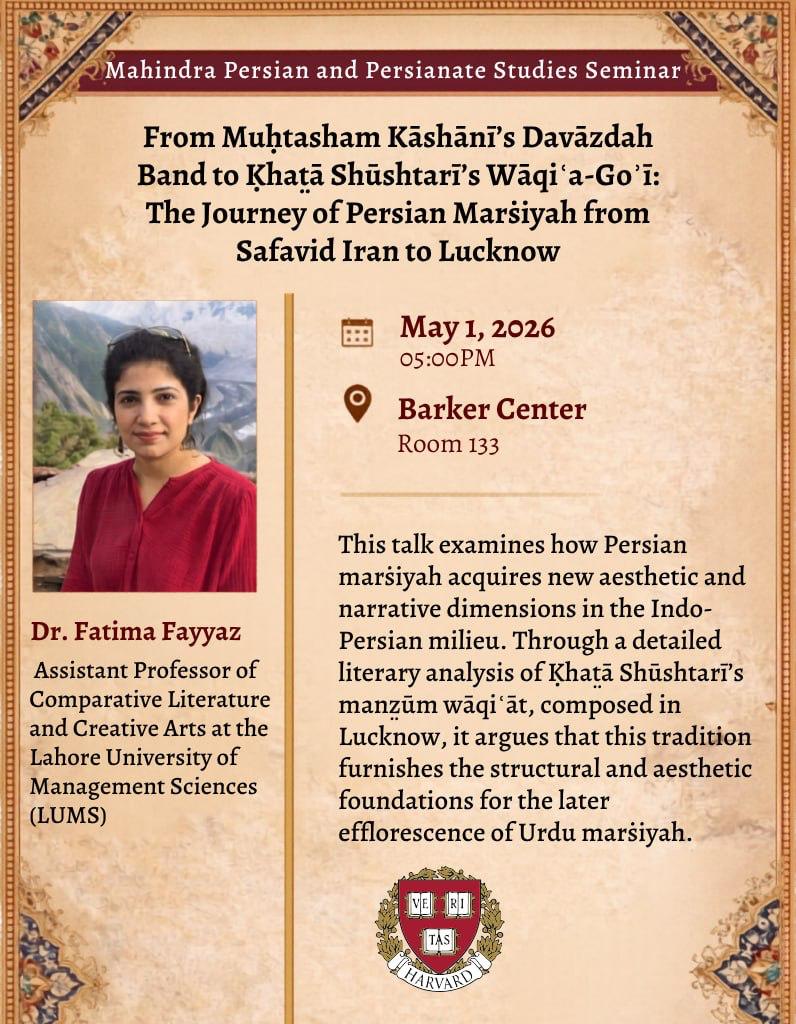
From Muḥtasham Kāshānī’s Davāzdah Band to Ḳhat̤ā Shūshtarī’s Wāqiʿa-Goʾī: The Journey of Persian Marṡiyah from Safavid Iran to Lucknow

Date and Time
Location
PERSIAN AND PERSIANATE STUDIES
SPEAKER: Fatima Fayyaz, Harvard University
The pivotal redirection of royal patronage from courtly panegyrics to devotional poetry under the Safavid ruler Shāh Ṭahmāsp—most notably exemplified by Muḥtasham Kāshānī’s Davāzdah Band—marks a decisive shift in Persian poetic culture and the articulation of Shiʿi identity. While this turn might suggest a sustained flourishing of marṡiyah (elegy) within Iran, tażkirahs (biographical anthologies of poets) of Safavid-era indicate otherwise. The most significant expansion of the genera of marṡiyah occurs beyond Safavid borders, particularly in Mughal India. This talk traces this transregional movement through Iranian émigré poets such as Ḥaydar Tūnī, Ẓahūrī Turshezī, Mullā Muqbil Iṣfahānī, Muḳhliṣ Kāshī, and Mullā Ḳhat̤ā Shūshtarī, who found patronage in the Deccan, Gujrat, Bijapur and especially in the Shiʿi court of Lucknow in Awadh. Focusing on the tradition of wāqiʿa-goʾī (episodic narrations of Karbala), in which many of these migrant Iranian poets composed their marṡiyahs, this talk examines how Persian marṡiyah acquires new aesthetic and narrative dimensions in the Indo-Persian milieu. Through a detailed literary analysis of Ḳhat̤ā Shūshtarī’s manz̤ūm wāqiʿāt, composed in Lucknow, it argues that this tradition furnishes the structural and aesthetic foundations for the later efflorescence of Urdu marṡiyah.
About the speaker
Dr. Fatima Fayyaz is Assistant Professor of Comparative Literature and Creative Arts at the Lahore University of Management Sciences (LUMS), Pakistan. Her research focuses on Persian mystical and epic literature across Iran and the broader Persianate world, with particular attention to Central and South Asia. She received her PhD in Persian literature from the University of Tehran, where her doctoral research examined hagiographical texts of Central Asian Sufi orders and the cross-cultural connections between Central Asian and Indian mystics in the fifteenth and sixteenth centuries. Her work also engages extensively with Firdausī's Shāhnāmeh and its profound influence on various literary genres in 19th-century South Asia, including the Urdu ġhazal, dāstān, and marṡiyah.